Ayurvedic massage and bodywork in Ariège
Body-based approaches to release tension, calm the nervous system and support periods of prolonged stress, transition or health imbalance.
Formats adapted to your current state
The bodywork offered at ReViva can play different roles throughout your health journey: providing space to slow down during particularly demanding periods, supporting your return to balance after prolonged stress or burnout, or helping you maintain your health when sustained pressure is part of everyday life.
Ayurvedic massage offers time to unwind, slow down and reconnect with your body. Personalised bodywork forms part of a broader approach and is selected according to your individual health needs.
Recovery spaces
These massages offer an accessible first approach, ideal if you are experiencing tension or overload, without yet committing to deeper work. They are particularly suitable if you wish to quickly release accumulated tension and support your day-to-day wellbeing
Head or foot massage
Act quickly on the nervous system

This short format is designed to offer a targeted massage on a specific area of the body (either head or feet), recognised in Ayurveda for its central role in recovery and nervous system regulation.
Duration: 45 minutes (including 30 minutes of massage)
Contribution: Access first
Full body massage
Support overall recovery
This format supports recovery with a more global effect than a localised massage (head or feet), while remaining suitable as an introduction to Ayurveda.
Duration: 60 minutes (including 45 minutes of massage)
Contribution: Access first
Ongoing Care – Personalised Courses of Ayurvedic Bodywork
Ayurveda offers a wide range of body techniques, using oils, milks, herbs, powders, decoctions, dry heat or steam. However, these techniques only take on their full meaning when they are selected and combined according to the individual, their current condition and the objective of the care being provided.
However, these techniques only take on their full meaning when they are selected and combined according to the individual, their current condition and the objective of the care being provided.
At ReViva, personalised treatments are therefore not offered as standalone, à la carte services. They are organised into three-session modules, designed to provide progressive care, adapt the techniques used and reassess their suitability over time.
To ensure precise adaptation, these sessions are reserved to:
- people who have already completed a foundational assessment at ReViva,
- or those referred by a healthcare professional or practitioner, providing a file or written request
Soothing and Nourishing
A course of sessions focussed on soothing, warmth and bodily nourishment. Depending on the assessment, bodywork may aim to:
Encourage relaxation and rest;
Provide softness and nourishment to the tissues;
Support individuals during periods of tension or fatigue.
Format: 3 sessions of 1 hour and 15 minutes.
Continuation: One or more additional modules may be offered following reassessment.
Contribution: Commitment first
Stimulation and Activation
A course of sessions focussed on stimulation and mobilisation. Depending on the assessment, bodywork may aim to:
Stimulate and mobilise the tissues;
Address sensations of heaviness or stagnation;
Support a feeling of lightness and vitality.
Format: 3 sessions of 1 hour and 45 minutes.
Continuation: One or more additional modules may be offered following reassessment.
Contribution: Commitment first
Localised Relief
A course of sessions designed around a specific anatomical region or localised concern. Depending on the assessment, bodywork may aim to:
Support mobility and joint comfort;
Support skin comfort and balance;
Support certain bodily functions, such as respiration or digestion.
Format: 3 sessions of 1 hour and 45 minutes.
Continuation: One or more additional modules may be offered following reassessment.
Contribution: Commitment first
Choose your massage or course of ayurvedic bodywork
Why isn't personalised bodywork offered à la carte?
Ayurvedic treatments act on physiology and on the overall regulation of body and mind. Their effectiveness relies on precise adaptation to the individual: constitution, current imbalances, season, climate, energy level, and ongoing process.
Offering these sessions without a prior framework would mean separating the technique from its meaning. Unlike introductory massages, these techniques are part of an individualised approach.
At ReViva, the choice of techniques, substances and rhythms is therefore made on a case-by-case basis, with attention to:
Safety: checking for potential contraindications and adapting bodywork to the individual’s situation.
Personalisation: selecting and adjusting techniques according to the assessment and the individual’s response.
Coherence and respect for tradition: placing bodywork within a considered progression, in accordance with the traditional principles of Ayurveda.
Overview of some of the techniques used
What to expect during a session?
How does an Ayurvedic massage work?
Before
A short form is sent before the session to check for any contraindications. This ensures your comfort, safety, and the quality of the treatment.
During
At the beginning of each session, a short exchange with your practitioner also helps clarify your needs at that moment (fatigue, agitation, tension, need to recentre). The massage is then adapted within a simple protocol, respecting your current state. The session then lasts approximately 30 minutes (head or feet) or 45 minutes (full body).
After
A rest and integration period follows, before your leave with one or two recommendations to maximise the benefits of the session.
Shiroabhyanga – Head massage
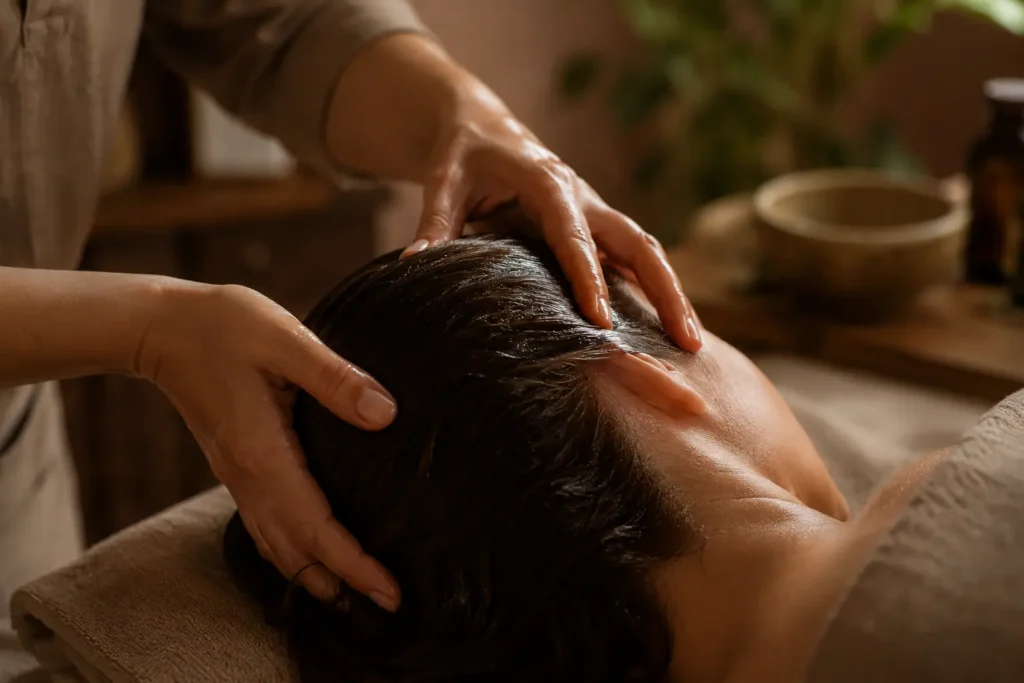
Shiroabhyanga focuses on the head only (scalp, face, neck, upper back).
The massage is performed with warm Ayurvedic oil, selected according to the season and your needs.
Benefits experienced:
- Relaxation and mental clarity
- Sense of lightness
- Reduced stress
- Improved sleep
- Feeling of grounding and centring
Padabhyanga – Foot and leg massage
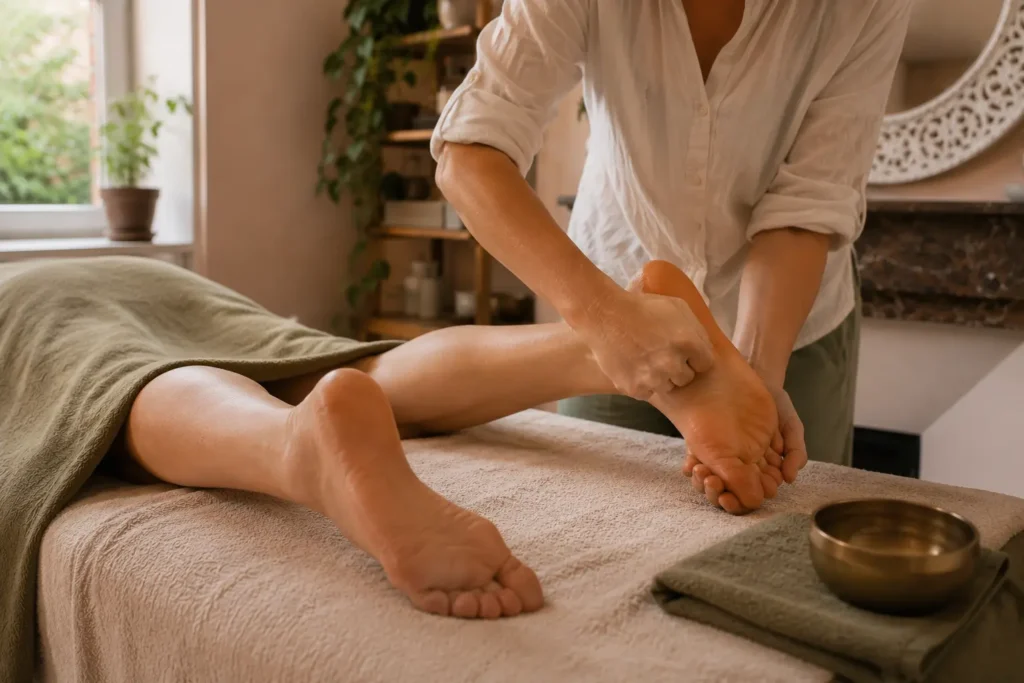
Padabhyanga focuses on the feet, ankles and calves. According to Ayurveda, the soles of the feet contain many specific energy points (marma) connected to organs and senses. By massaging the feet, the whole body is stimulated.
This massage is particularly useful:
- In cases of mental overload
- To support sleep and emotional stability
- When Shiroabhyanga is not appropriate (nasal congestion, facial acne, etc.), or if you prefer not to have oil in your hair
Abhyanga – Full body massage
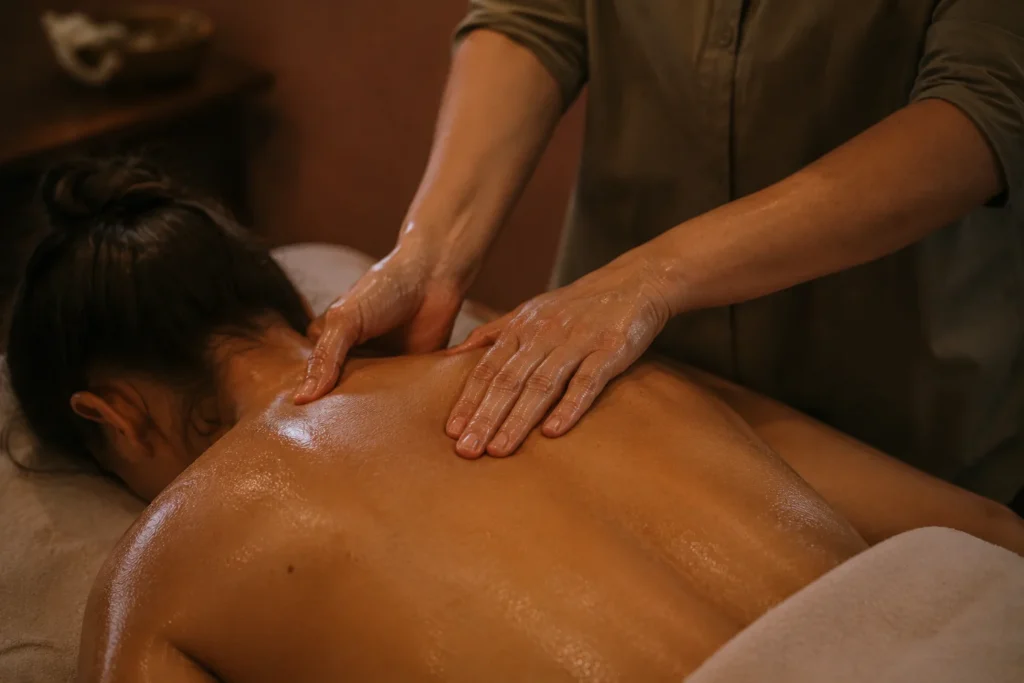
Abhyanga is a full-body massage with warm oil. It acts on the skin, muscles and circulation, while stimulating nerve endings. It therefore produces a global effect, both physical and mental, calming the mind and supporting metabolism.
Abhyanga is particularly useful:
- After periods of intense work, frequent travel or overwork
- In cases of tension or mental agitation
- In cases of dryness or sensitivity to cold
How Does a Personalised Course of Sessions Work?


Before
Before starting, a preparation form is used to check for potential contraindications. The initial assessment establishes the course's direction, its objectives and the techniques that may be considered.
During
Each appointment includes time for welcoming and preparation, followed by the planned bodywork. The techniques, substances and combinations used may vary from one appointment to another, depending on the defined objective and the progress observed. The practitioner explains the choices made so that you understand the reasoning behind each session.
After
Time for rest and integration is provided at the end of each session. Tailored recommendations may be given following the appointment. A reassessment allows progress to be reviewed, taking into account observed changes, personal experience, tolerance of the techniques and the relevance of continuing. Depending on this assessment, the course may be considered sufficient, or may be followed by one or more additional courses of personalised bodywork.
Which Techniques May Be Used?
Techniques are not automatically assigned to each course of bodywork. They are selected by the practitioner according to the assessment, the intended objective and the precautions specific to each situation.
Techniques that may be included in the Soothing and Nourishing course
- Abhyanga
- Padabhyanga
- Shiroabhyanga
- Shiropichu
- Karna Purana
- Navara Kizhi
Other techniques suited to the assessment, where appropriate
Additional techniques such as Dhara or Shirodhara may be considered as an extra when indicated. The specific preparations required for these treatments are charged separately, with the additional cost presented before the treatment is carried out.
Techniques that may be included in the Stimulation and Lightening course
Abhyanga and other appropriate preparatory treatments
Udvartanam
Valuka Sveda
Pinda Sveda (Patra, Churna)
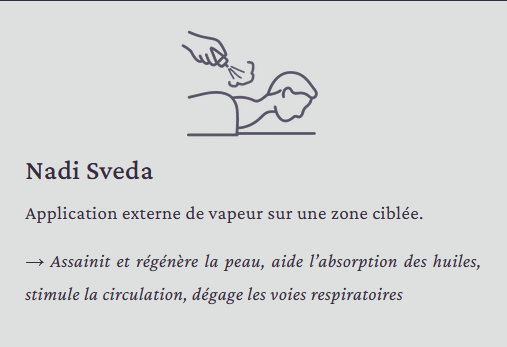
Nadi Swedana
Other techniques suited to the assessment, where appropriate
When the use of specific herbal decoctions or Ayurvedic oils is indicated and offered as part of the course, their cost may be charged separately, with the additional cost presented before the treatment is carried out.
Techniques that may be included in the Targeted Treatments course
Abhyanga and other appropriate preparatory treatments
Basti (Griva, Janu, Kati, Nabhi, Hrdaya)
Lepam
Pinda Sveda (Patra, Churna, Valuka)
Other localised techniques, where relevant
When the use of specific herbal decoctions or Ayurvedic oils is indicated and offered as part of the course, their cost may be charged separately, with the additional cost presented before the treatment is carried out.
Who can access personalised bodywork?
Personalised sessions are available to:
- people who have completed a Foundational Assessment at ReViva,
- or those referred by another practitioner or a doctor, providing a file or written request
How many sessions are needed?
In Ayurveda, the duration of care depends on the intended objective, the nature and duration of the imbalance, the individual’s constitution and the techniques used.
Depending on the situation, bodywork may be organised into closely spaced sessions over several days, cycles spread over several weeks, or a longer-term schedule.
There is therefore no universal number of sessions that can guarantee the achievement of a particular objective. An initial course of three sessions provides an opportunity to begin the work and observe the response of the client. It may be sufficient by itself, or need to be complemented by additional sessions.
Unsure which format is best for your situation?
A massage is often the first step to release pressure and begin recovery. If you are hesitating between formats, you can contact me so we can choose the most suitable option together.
Photography of personalised bodywork: Eloïse Montegut – Djoyo, communication en Ariège – www.djoyo.fr