
Oltre i Test sul Burnout: una Valutazione Multidimensionale dello Stress Cronico e dei Profili di Esaurimento
Contents
In this article, we will explore:
Prefer to skip the theory and begin directly?
Why burnout is difficult to define
If you’ve opened this page, chances are that you feel something is off. Perhaps you feel emotionally flat, irritable or anxious. Perhaps you feel exhausted, overwhelmed, or trapped in a constant “wired-but-tired” state where your body feels depleted but your mind cannot properly slow down.
You may even have already taken an online burnout test or chronic stress self-assessment. Perhaps you felt that the results were incomplete, overly simplistic, or somehow disconnected from your actual experience, leaving you wondering what to do next.
This is a common problem with many burnout tests: they are often designed to answer a relatively narrow question:
“Are you or are you not experiencing burnout?”
Their purpose is generally to assign you to a category through a simplified score. Yet this approach becomes problematic when we consider the definition of burnout itself.
Defining burnout
Burnout is not a universally defined medical diagnosis. Also, you cannot determine whether you are experiencing burnout in the same way you can determine whether you have a fever or are suffering from anaemia: there are no clear biomarkers of burnout.
Different countries and healthcare systems define burnout differently. Some frameworks describe burnout primarily as work-related stress and emotional exhaustion. Others consider it a broader syndrome involving cognitive fatigue and emotional dysregulation. Many countries do not formally recognise burnout as a distinct diagnosis at all.
As a result, burnout assessments vary considerably depending on the framework used. In concrete terms, this means that two different burnout assessments may well produce different results for the same person.
The issue is not that these tests are “wrong”. It is that they are measuring different things depending on the model used.
Burnout Frameworks and Their Limits
One of the most influential frameworks related to burnout is the Maslach Burnout Inventory (MBI), developed by Christina Maslach, which remains widely used in both research and workplace settings.
The MBI primarily evaluates three separate dimensions:
- emotional exhaustion,
- depersonalisation or cynicism,
- reduced professional efficacy.
Other frameworks, such as the Copenhagen Burnout Inventory, place greater emphasis on exhaustion itself, while distinguishing between personal exhaustion, work-related exhaustion, and exhaustion associated with client or patient interactions.
These frameworks are valuable because they help clinicians, researchers, and employers identify patterns of distress associated with prolonged stress exposure. They also play an important practical role in countries where burnout may be recognised within occupational health systems.
In France, where I am based, establishing whether a person fits a formal occupational burnout framework can be extremely useful. This may open pathways towards sick leave (arrêt de travail), occupational evaluation, or workplace adjustments, as emphasised by the Haute Autorité de Santé (HAS) guidelines on burnout identification and management.
However, these assessment frameworks also have limitations.
What about burnout outside the workplace?
One of the characteristics that distinguishes burnout from many other forms of psychological distress is that burnout is traditionally understood as emerging within a specific context of prolonged demand and insufficient recovery.
Historically, this context has most often been the workplace, partly because work occupies a major portion of adult life and because occupational stress has been extensively studied. This is why many burnout frameworks — including the Maslach Burnout Inventory and Copenhagen Burnout Inventory — focus primarily on occupational functioning.
However, problematic environments are not limited to formal paid employment. Academic studies, certain family roles, or temporary relational, social and financial situations may also generate similar levels of distress.
This helps explain why some people strongly recognise themselves in burnout experiences despite not fitting neatly into occupational burnout frameworks or qualifying for a formal diagnosis.
What about the factors leading to burnout?
It is also important to understand that burnout rarely appears suddenly and out of nowhere. In most cases, it develops progressively through prolonged imbalance — and not only through chronic stress (prolonged demand and insufficient recovery), but also through under-stimulation (often described as “boreout”).
This perspective is explored in more detail in this broader article on chronic stress, burnout, and the Ayurvedic approach to stress dysregulation.
Burnout frameworks primarily assess the degree to which burnout characteristics are already present, rather than exploring the broader patterns that may progressively contribute to dysregulation over time.
For this reason, diagnosis alone is not always enough to fully understand:
- what is happening in a person’s system,
- what factors are driving the imbalance,
- what is the person’s recovery capacity,
- or what may be required for meaningful recovery.
This is why the assessment presented in this article focuses more broadly on patterns of regulation, stress load, recovery capacity, and physiological or psychological imbalance — within which burnout may represent one possible endpoint or manifestation.
In practice, this means that a person does not need to wait until they are completely exhausted or disconnected before beginning to understand and address the patterns that are pushing their system out of balance.
An Ayurvedic Perspective on Burnout
While diagnostic frameworks and burnout assessments can be useful, they do not always help us fully understand how a specific individual is affected, what factors are maintaining the imbalance, or what may be required for a meaningful recovery.
This is where a multidimensional assessment can become useful.
Ayurveda is an approach that is less interested in assigning people to a strict diagnostic category, and more interested in understanding:
- what patterns of dysfunction the person is experiencing,
- what has caused them,
- and what continues to fuel them.
Rather than asking only:
“Do you have burnout?”
the question becomes:
“What exactly is happening in your system right now?”
This kind of mapping can be useful both for people already experiencing burnout, and for those who recognise earlier signs of dysregulation before reaching a point of collapse.
These questions are very helpful for orienting prevention and recovery strategies, irrespective of official diagnoses. They allow us to better understand:
- the conditions that allow dysregulation to emerge,
- the forms that dysregulation is taking in that specific individual,
- and the factors that may need to change in order for recovery to occur.
Consider these two examples.
Meredith is a senior manager in a highly competitive company. Over the past few years she has progressively sacrificed sleep, regular meals, exercise, and personal relationships in order to maintain performance.
She now sleeps around five hours per night and struggles to properly switch off mentally. She becomes impatient and reactive with colleagues, and feels increasingly cynical about her work. She feels trapped between exhaustion and overdrive. Despite being depleted, she cannot stop pushing herself.
She experiences:
- migraines,
- elevated blood pressure,
- gastrointestinal disturbances,
- emotional volatility and irritability,
- impulsive decision-making.
Although she continues to perform at a high level externally, she increasingly feels that nothing she does is ever enough, and that her work no longer brings any sense of accomplishment.
Stanley works in a large administrative organisation with repetitive tasks and little social connection.
He struggles to wake up in the morning, feels persistently fatigued, and often functions on “autopilot”.
Tasks that once felt manageable now feel heavy and meaningless: he increasingly delays responsibilities, arrives late to meetings, and avoids interactions with colleagues whenever possible.
Over time he has developed:
- chronic fatigue,
- low mood,
- emotional numbing,
- recurrent illnesses,
- nausea,
- memory impairment,
- and a growing sense of loneliness and resignation.
He performs tasks mechanically, with little sense of involvement or accomplishment, and often copes through withdrawal and avoidance, becoming increasingly detached from both his work and personal life.
These two individuals are both experiencing “burnout,” as defined by Christina Maslach. Both are experiencing in fact high degrees of
- emotional exhaustion,
- depersonalisation,
- and reduced professional efficacy.
Yet their physiological and psychological presentations, and the paths that led to their current state, are markedly different. Although burnout is often associated with overload and overwork, some individuals progressively move toward exhaustion through chronic disengagement, under-stimulation, loss of meaning, or prolonged emotional withdrawal.
These are just two among many individual examples, but they stand to show that very different trajectories may converge toward similar states of exhaustion. Most importantly, recovery needs will also be different despite similar burnout scores.
This is why Ayurveda focuses less on labels and more on patterns of imbalance. The important question is therefore: “What factors are shaping my current state, and what does my system need in order to recover?”
This is the foundation of a more personalised approach to understanding burnout manifestations, and recovery needs.
Introducing the Multi-Dimensional Assessment
This assessment does not determine whether you “officially” have burnout as a medical or occupational diagnosis.
Its purpose is instead to help you develop a clearer understanding of:
- the state of your nervous system,
- which factors may be contributing to your imbalance,
- whether your recovery capacity is sufficient,
- and how imbalance may be expressing itself physically, emotionally, cognitively, and behaviourally.
This information may help orient meaningful next steps, support self-awareness, and provide useful context for discussions with healthcare professionals where appropriate, whether you “officially” have burnout or not.
The assessment is divided into four complementary modules.
1. Activation Pattern
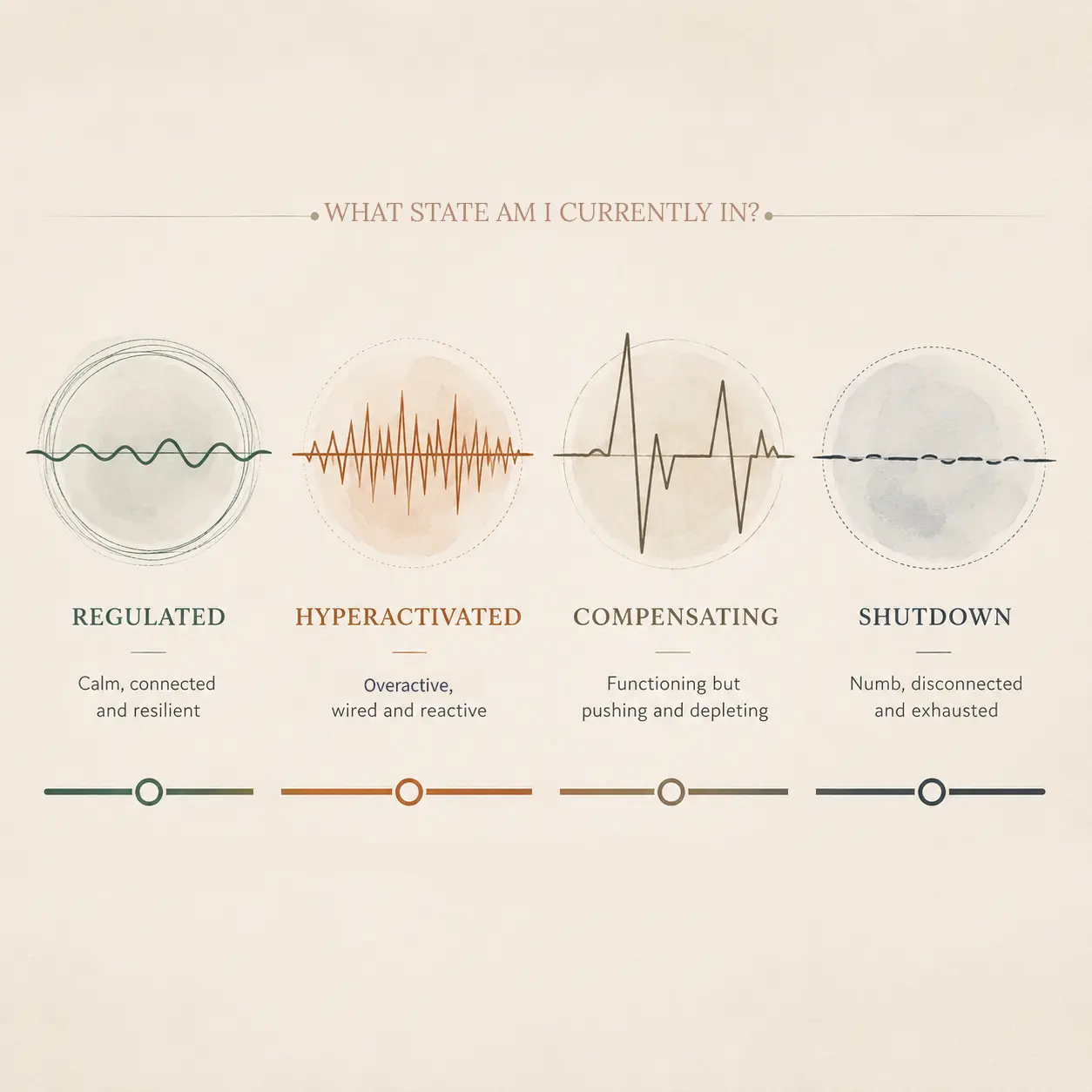
This module explores the current pattern through which your nervous system is currently responding to the solicitations of you daily life. It is partly inspired by the work of Hans Selye and his General Adaptation Syndrome model, which describes how the body responds to stress through stages of alarm, resistance or exhaustion.
However, note that these patterns are not considered here as linear or sequential, and that their causes may not be limited to what we traditionally define as “stress exposure.” Indeed, factors that we don’t intuitively associate with « stress », like boredom, lack of interest, disengagement, may also lead to these states.
This section thus examines whether your system is tending toward:
- regulation
- hyperarousal,
- compensation,
- or shutdown.
Understanding your current pattern provides valuable insight into how strained, dysregulated, or under-engaged your nervous system currently is, and helps orient recovery strategies.
2. Current Load Profile
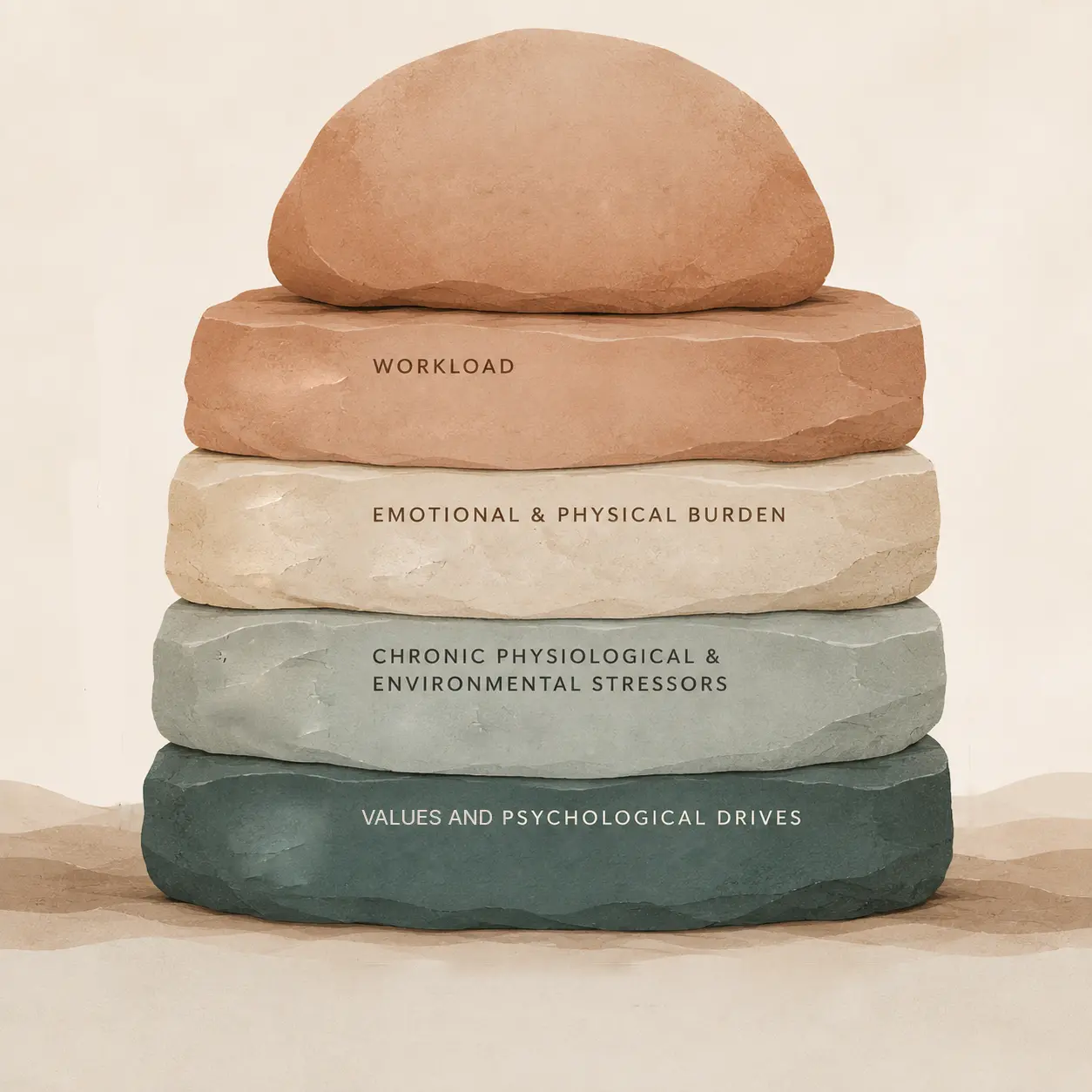
“What may be pushing my system out of balance?”
This module examines the different factors that may contribute to dysregulation and exhaustion over time. It is based on both burnout and boreout literature and chronic stress research.
These contributing factors may include:
- workload,
- emotional, relational or physical burden,
- social and environmental factors,
- personal values,
- and internal psychological drives.
The goal is to identify the factors that erode your energy and resilience, since Ayurveda gives great importance to identifying causes of imbalance. Once the causes are identified, they can in fact be removed or mitigated.
If causes are not identified, instead, attempting to address dysfunction may become little more than symptom management.
3. Recovery and Resilience Foundations
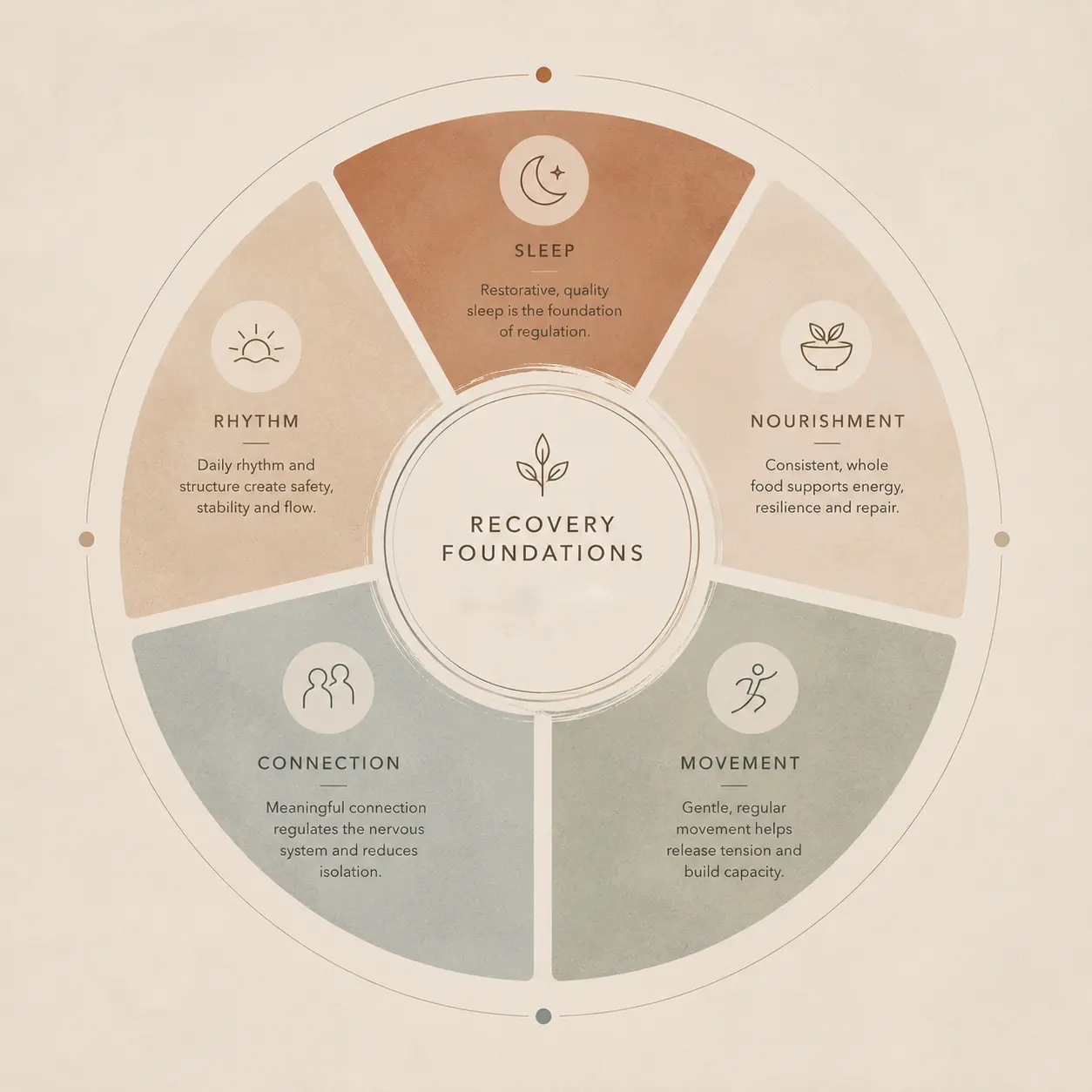
“Are my daily habits supporting resilience?”
Two people burdened by similar adverse elements may respond very differently. This can often be dismissed as luck, chance, or genetics, but the reality is that each person has a different capacity for restoration, adaptation and self-regulation.
Without sufficient rest and disengagement, a normal and adaptive stress response can progressively become maladaptive. However, some behaviours that temporarily feel comforting – such as inactivity, withdrawal, overindulgence – may also paradoxically impair resilience.
This module therefore explores whether your daily habits and lifestyle patterns are supporting recovery — or quietly working against you.
It is based both on modern burnout and chronic stress literature, as well as on principles found within classical Ayurvedic texts regarding rest, nourishment and recuperation.
This is one of the major differences between a multidimensional assessment and many conventional burnout tests. Indeed, sometimes improving these foundations can significantly increase resilience, even in the face of major stress loads.
4. Imbalance Pattern
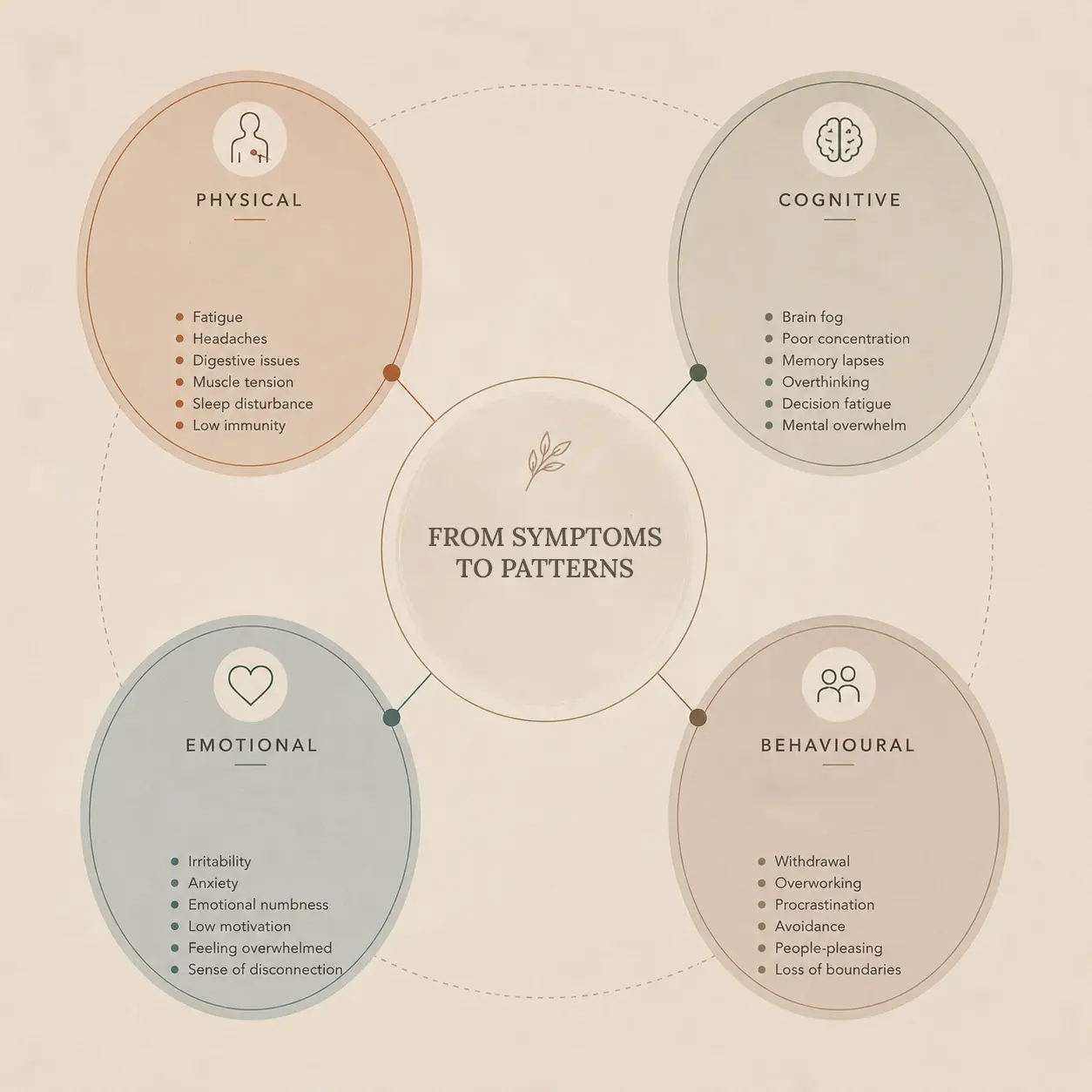
“How is imbalance expressing itself in my system?”
Burnout is defined in different ways partly because the range of symptoms through which it may express itself is extremely broad.
It is important to remember that many symptoms associated with burnout may also overlap with other medical or psychological conditions. Persistent fatigue, mood changes, cognitive difficulties, sleep disturbances, low mood should not automatically be assumed to result from burnout alone.
Seeking support through one’s GP remains important in order to rule out other possible medical or psychological conditions such as depression, anxiety disorders, sleep disorders, or physical illness.
This module is based primarily on the Ayurvedic theoretical framework, which seeks to identify overarching patterns of dysfunction rather than viewing symptoms as isolated problems to be addressed individually.
The relevance of this approach is that, instead of ending up with a disconnected list of symptoms requiring separate symptomatic management, we can begin identifying the deeper pattern through which imbalance is manifesting.
This may include:
- depletion tendencies,
- overdrive tendencies,
- or congestive patterns.
Understanding these patterns helps orient the next steps towards regulation, resilience, and recovery.
Begin Mapping Your Pattern
Understanding burnout requires more than a single score or category. The goal of this assessment is to help you build a clearer picture of:
- what state your nervous system is in,
- what may be preventing recovery,
- and how imbalance is currently manifesting.
Need help making sense of your stress patterns?
If you would like personalised guidance, you can explore Reviva’s stress and burnout support services.
Sources that inspired this article and assessment
Burnout for Experts: Prevention in the Context of Living and Working. Springer, 2013.
The Trauma of Burnout: How to Manage Your Nervous System Before It Manages You. Grand Central Publishing, 2025.
Christina Maslach and Susan E. Jackson. Maslach Burnout Inventory Manual. Consulting Psychologists Press, 1981 / subsequent editions.
Tage Søndergaard Kristensen, Marianne Borritz, Ebbe Villadsen, and Karl B. Christensen. “The Copenhagen Burnout Inventory: A New Tool for the Assessment of Burnout.” Work & Stress, 2005.
Hans Selye. The Stress of Life. McGraw-Hill, 1956.
Aṣṭāṅga Hṛdayam, traditionally attributed to Vagbhata.
van Hooff, M. L. M., & van Hooft, E. A. J. “Boredom at Work: Towards a Dynamic Spillover Model of Need Satisfaction, Work Motivation, and Work-Related Boredom.” European Journal of Work and Organizational Psychology, 2017.