Where Are You, Really?
We often look for one diagnosis to explain everything. But health is more like a landscape than a single point. Build your Adaptive Health Map and explore how your current adaptive patterns, lifestyle, stress load and natural tendencies fit together.
Contents
Health is a landscape, not a single point.
When something feels off and we’re unsure what is happening with our health, many of us instinctively look for a test that will tell us what’s wrong. It is also natural that we look for one explanation that makes sense of everything: I’m burnt out. It’s my hormones. It’s low dopamine. It’s high blood sugar.
We love a single explanation. Ideally one with the satisfying power of a detective revealing the murderer in the final five minutes.
“It was cortisol.”
Roll credits.
Unfortunately, even if sometimes these explanations are useful or reassuring, biology is rarely that simple.
A map is more useful than a single answer
How you feel today reflects the interaction of many factors: your natural tendencies, the demands placed upon you, the resources available for recovery, and the adaptations your body and mind have developed over time. It’s tempting to look for one score, one blood marker or one diagnosis that explains everything. Preferably one that can be put in bold. More often than not, each offers only one piece of a much larger picture.
This self-assessment doesn’t look for one verdict. Instead, it gradually builds a map from several complementary layers. Each layer reveals something different; together, they help understand the landscape you’re navigating.
Fortunately, complexity is not the same as confusion. A map is complex, but it makes navigation easier. Likewise, this assessment isn’t trying to overwhelm you with dozens of variables. It’s trying to organise them into a coherent picture. The aim is to help you understand not only where your system is today, but also how it got here and which direction it may wish to take next.

• Draw a map before choosing a direction.
A diagnosis can be invaluable. It provides a shared language, helps us communicate with healthcare professionals, may open access to treatment or workplace accommodations, and can reassure us that our experience is recognised.
But knowing the name of the place you’re at does not, by itself, tell you how you arrived there, what is keeping you there, or which direction is most likely to lead you where you want to go next. If you don’t understand the terrain, choosing a route is mostly guesswork.
This assessment brings together several complementary perspectives that, taken together, form a map. That map can then guide conversations with practitioners, help you make sense of your own experience, and provide a more informed basis for deciding which direction is worth exploring next.
• Observe before you explain
A map is only as reliable as the observations it is built upon. The value of this assessment depends less on finding the “right” answer than on describing your experience as faithfully as you can. The more accurately you can observe your experience, the more useful the map becomes.
Before asking why something is happening, we first need to understand what is actually happening. As you move through the questions, try to answer from direct experience rather than from habit, assumptions or the image you have of yourself.
Try not to answer as your LinkedIn profile would.
Adaptable. Resilient. Thrives in dynamic environments.
This is useful for getting hired. It is considerably less useful for figuring out why you’ve been waking up at 3:17 a.m. every night this week.
Try this small test. Without looking back at your recent life, complete this sentence:
“My sleep is generally…”
Now complete this one:
“Over the last week, my sleep has…”
Notice how different those two questions feel.
The first asks you to retrieve an identity. The second asks you to retrieve observations.
• Understand before you judge
Throughout this assessment, try to resist classifying your experiences as good or bad, healthy or unhealthy, normal or abnormal. Those categories may be useful at times, but they can also prevent understanding. This assessment—and Ayurveda more broadly—approaches health differently. Rather than asking whether a response is inherently desirable or undesirable, it asks whether it is appropriate for this particular person, in this particular situation, at this particular moment.
This isn’t about judging yourself. It’s about understanding what your organism is trying to do. Every adaptation once served a purpose. Even pushing through exhaustion. Even losing your appetite. Even becoming detached or emotionally numb. Rather than asking whether these responses are “good” or “bad”, begin by asking when they appear, what seems to sustain them, and what they may be trying to achieve.
• Accept what you don't yet know
A questionnaire is usually designed to eliminate uncertainty. This one doesn’t. If you don’t know, don’t answer.
There are no bonus points for confidently making things up.
Rather than a failure, “I don’t know” is valuable information: it tells you which parts of the map you have not yet had the opportunity to explore. A question mark is still a landmark.
If this happens often, consider it an invitation rather than an obstacle. The accompanying articles on self-observation may help you gradually fill in the parts of the map that are still blank.
The assessment at a glance
This assessment is organised into four complementary modules + an optional fifth module. Each explores a different aspect of your health and adaptive capacity.
None of these questions is sufficient on its own.
Your current state is not the same thing as your baseline tendencies. And your stress load is not the same thing as your adaptive capacity.
The interesting information lives in the relationships between them.
You may complete the modules in order, or return to them individually at a later stage. If this is your first time, I recommend working through them sequentially.
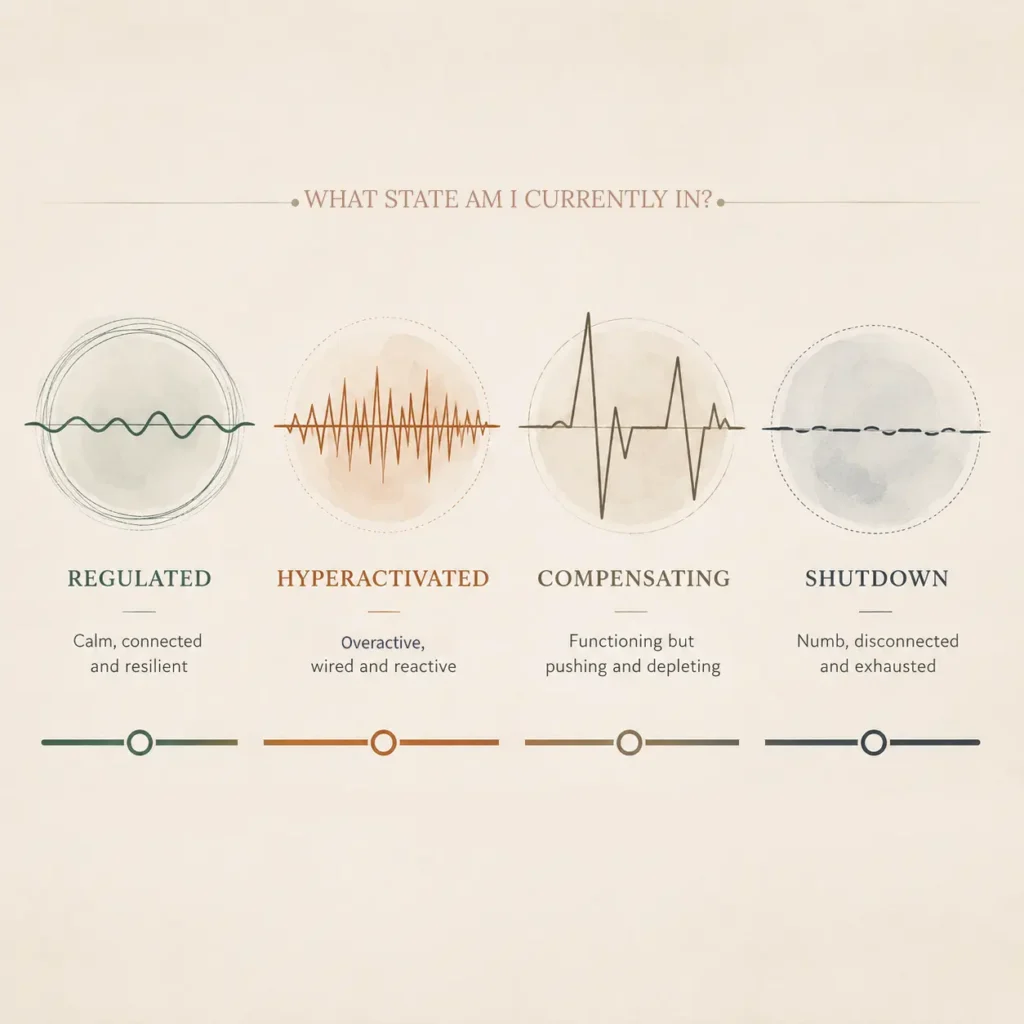
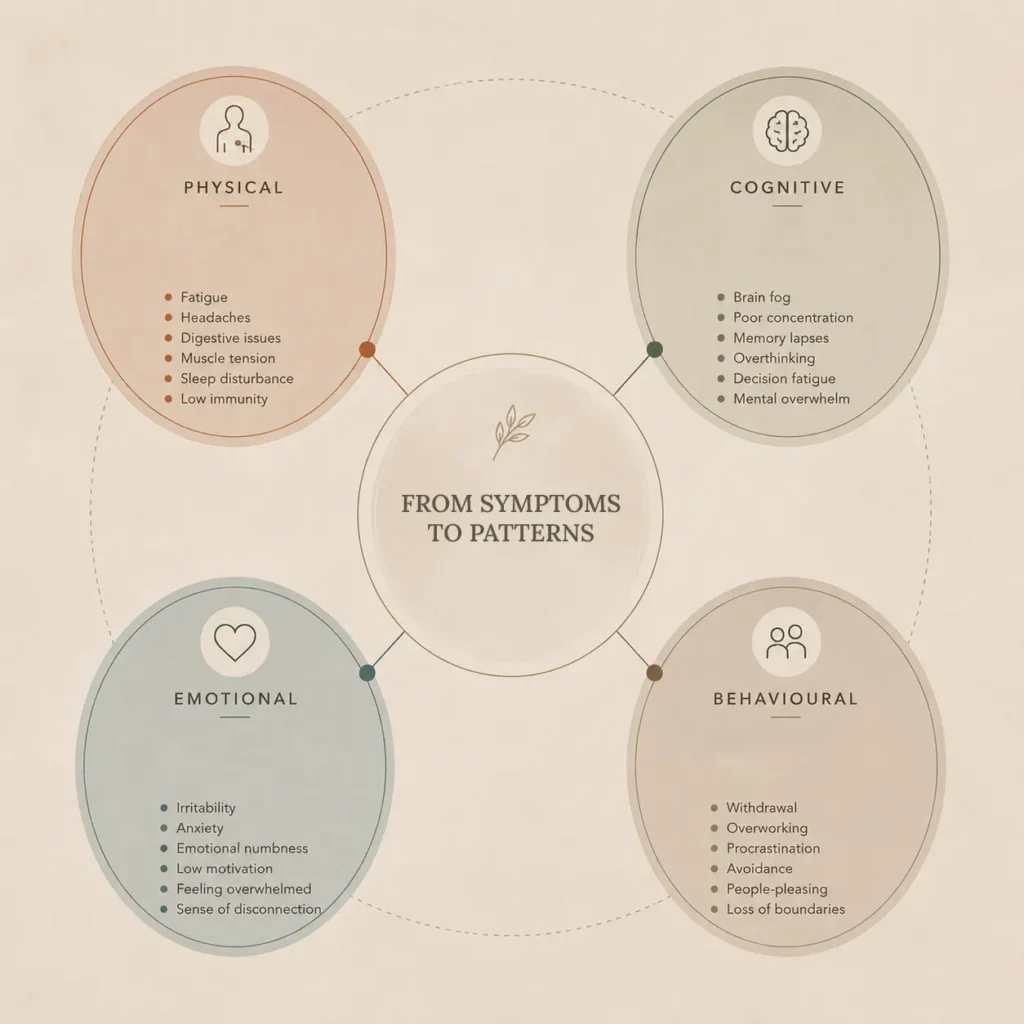
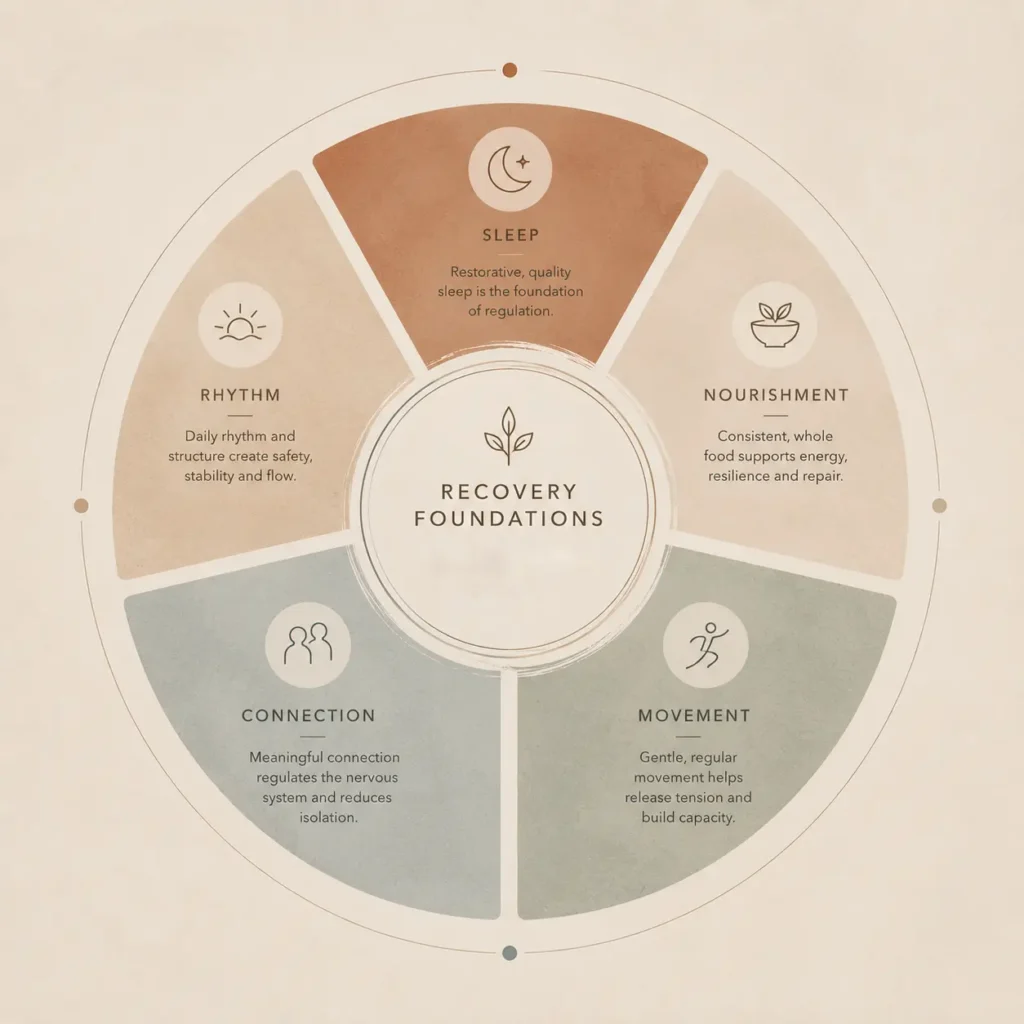
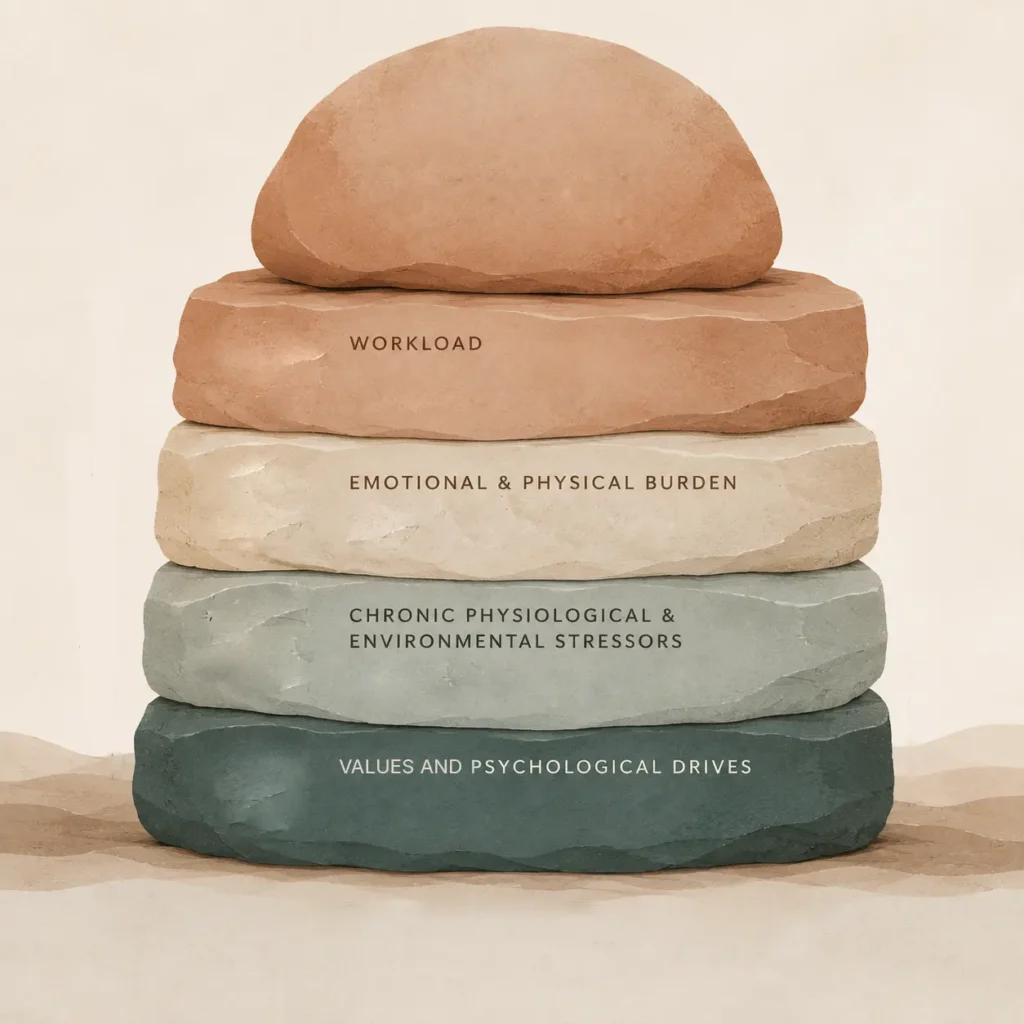

No assessment can capture every aspect of a person’s life, and this one is no exception. But by exploring these complementary perspectives, you’ll build a clearer understanding of where your system is today—and a more reliable foundation for deciding where to go next. Please remember that this assessment is a self-reflection tool, and does not substitute medical diagnosis or care.

Know someone looking for the one explanation that will finally make everything make sense?
Share this map with them instead.
Further Reading and References
Sources that inspired this adaptive health assessment
Aṣṭāṅga Hṛdayam, traditionally attributed to Vagbhata.
Burnout for Experts: Prevention in the Context of Living and Working. Springer, 2013.
The Stress of Life. Hans Selye. McGraw-Hill, 1956.
The Trauma of Burnout: How to Manage Your Nervous System Before It Manages You. Claire Plumbly. Grand Central Publishing, 2025.
van Hooff, M. L. M., & van Hooft, E. A. J. “Boredom at Work: Towards a Dynamic Spillover Model of Need Satisfaction, Work Motivation, and Work-Related Boredom.” European Journal of Work and Organizational Psychology, 2017.
Why Zebras Don’t Get Ulcers. Robert M. Sapolsky. Holt Paperbacks, 2004
Note: comments are disabled on this blog in order to preserve a space for reading and reflection without active moderation.
I am not able to monitor or respond to public comments. For any remarks, reflections, or exchanges, you can contact me via the contact page or by email (contact@consultationsayurveda.com).